Structured term based group classes, with a private lesson option for anyone who wants to move faster, give working adults the best mix of progress and convenience. Both live online (Zoom) and in-person formats are widely available. The fastest way to know where you stand is to book a placement test or a trial class before committing to a term.
TL;DR:
- Most adults should expect to spend several months in regular classes to reach conversational proficiency, with intensive courses shortening the calendar but not the total study hours.
- Online and in-person classes of six to eight students offer significantly more speaking practice per learner than larger lecture-style groups.
- Private lessons are suitable for targeted, fast progress but come at a higher cost and require more weekly hours, making scheduling critical.
- Choosing the right course depends on goals, pace, and budget, with a placement test and clear syllabus as key indicators of quality.
- Supplementing classes with daily exposure through media, apps, and recorded lessons accelerates progress beyond classroom hours alone.
Table of Contents
- What Types of Korean Lessons Are Available in Singapore?
- What Can You Actually Achieve at Each Course Level?
- How Do You Fit Korean Classes Around a Full-Time Job?
- How Should You Choose Between Korean Courses?
- What Do Korean Lessons Cost, and How Much Time Do They Take?
- How Do You Actually Enroll in a Korean Course?
- Why Korean Explorer Is a Solid Fit for Adult Learners
- How Do You Judge a Korean School’s Reputation in Singapore?
- What Should You Expect From Instructors and Teaching Methods?
- What Cultural Immersion Comes With a Korean Course?
- What Supplementary Resources Should You Use Alongside Classes?
- The Real Trade-Off Between Speed and Convenience
- Ready to Start? Here’s How to Book Your First Lesson
- Where to Go Next
- Sources
- FAQ
What Types of Korean Lessons Are Available in Singapore?
Korean language classes in Singapore break down into a handful of formats, and picking the wrong one is the most common reason adult learners stall out. Each format trades speed against cost and flexibility differently.
- Regular term courses: weekly sessions spread across 8 to 12 weeks, built for steady, sustainable progress.
- Intensive or express blocks: compressed schedules that cover a term’s material in fewer weeks, with more class hours per week.
- Weekend or evening classes: designed around a standard work week, usually Saturday mornings or weekday evenings after 7 PM.
- Private one-on-one lessons: fully customized pacing, useful for travel prep, job interviews, or catching up after missed terms.
- Semi-private lessons: two or three learners sharing an instructor, splitting cost while keeping personalized attention.
- Corporate training: group sessions arranged for teams or departments, often focused on workplace vocabulary and business etiquette.
Delivery mode splits into in-person campus classes and live online Korean classes over Zoom, many of which include recorded access for review. Class size matters more than people expect: a group of six to eight gets far more speaking time per learner than a lecture-style class of twenty, and that difference shows up fast in how confidently someone can hold a conversation after a few months.
What Can You Actually Achieve at Each Course Level?
Course levels aren’t just labels. Each one maps to a specific, testable skill set, and knowing what “intermediate” or “advanced” actually means helps you avoid signing up for the wrong term.
- Beginner: Hangul literacy, basic sentence structure, and the ability to handle simple greetings, ordering food, and short introductions.
- Intermediate: broader grammar patterns, better listening comprehension, and enough vocabulary to handle role-play scenarios like making appointments or describing your day in detail.
- Advanced: near-fluent conversation, comfort with nuanced grammar, and workplace-ready business communication, including formal speech levels used in meetings or emails.
Established programs typically structure this progression as Fundamentals, Beginner, Intermediate, and Advanced tiers, each mapped to specific units and terms. A realistic estimate for reaching conversational intermediate ability is usually several regular terms, assuming two to three hours of class time per week plus some homework. Intensive courses compress that same content into fewer calendar weeks, but the weekly hour count goes up substantially, so total study time doesn’t actually shrink. It just gets packed tighter.
How Do You Fit Korean Classes Around a Full-Time Job?
Scheduling is where most adult learners either commit or quietly give up after two sessions. The format you pick should match your actual week, not your ideal week.
- Pick evenings or Saturdays first. Weekday evening slots after work and Saturday morning sessions are the two most common formats built specifically for employed adults.
- Decide between regular and intensive pacing. Regular terms suit people who want steady, low-pressure progress; intensive blocks suit anyone with a deadline, like an upcoming trip or a work assignment in Korea.
- Account for homework time. Most courses expect at least an hour of review per class session outside of class, and skipping this is the single biggest reason learners fall behind their cohort.
- Check the online logistics before enrolling. Live Zoom classes need a stable connection and a quiet space for speaking practice, and having recorded lesson access matters more than most people realize when a work meeting runs long and you miss part of a session.
How Should You Choose Between Korean Courses?
Start with your goal, not the schedule. If you want to chat with a partner’s family or watch dramas without subtitles, conversational courses are the right fit. If you need Korean for client calls or a transfer to a Seoul office, look specifically for programs that mention business communication as a course outcome.
From there, work through pace, budget, and delivery format in that order. A useful framework: goals first, then how fast you want to get there, then what you’re willing to spend, then whether online or in-person fits your week better.
Before enrolling anywhere, ask these questions directly:
- What does a typical lesson look like, and how much speaking time does each student get?
- What’s the instructor’s teaching background, and are they a native speaker?
- Is there a placement test or trial class before I commit to a term?
- What’s the average class size?
- Can I see a sample syllabus for the level you’re placing me in?
- What’s your policy on refunds or transferring to a different term if the schedule changes?
Pro Tip: Ask for the syllabus in writing before you pay anything. A school that can’t show you what week 4 covers usually can’t tell you what week 12 covers either.
Red flags worth walking away from: no placement test offered at all, vague answers about class size, and permanent “limited time” discounts that never actually expire. Genuine trial lessons and clear syllabi are strong indicators of that program’s ability to place you correctly and keep you progressing.
What Do Korean Lessons Cost, and How Much Time Do They Take?
Fees vary by format, and the gap between options is wide enough that it’s worth mapping out before you commit to a term.
- Group term courses: the most budget-friendly option per hour, typically running several weeks with one or two sessions weekly.
- Intensive courses: higher per-term cost due to more weekly class hours, but they compress the calendar time to reach the next level.
- Private lessons: the highest per-hour rate, but every minute is customized to your pace and goals, which can offset the cost if you’re catching up quickly or prepping for something specific.
Course listing directories show a wide range of fee structures and start dates across providers, which makes comparing options directly before you contact any school worthwhile. Multi-term packages and corporate group rates are the two most reliable ways to lower your per-hour cost without sacrificing instruction quality. If a provider offers a package discount for booking several terms upfront, that’s usually a better deal than paying term by term, as long as the syllabus and instructor stay consistent across those terms.
How Do You Actually Enroll in a Korean Course?
Enrollment is more straightforward than most first-timers expect, and it usually takes less than a week from first contact to sitting in your first class.
- Reach out to the school with your goals (conversational, business, or exam-focused) and your available time slots.
- Take a placement test or level check. Placement tests typically assess reading, listening, speaking, and basic grammar to confirm the right starting level.
- Pick your schedule and pay. Once your level is confirmed, you’ll choose a term or private slot and complete payment before orientation.
No special documents are required for adult courses. Bring a notebook, and if you’ve studied any Korean before, mention it during the placement test so the instructor can adjust accordingly.
Why Korean Explorer Is a Solid Fit for Adult Learners
Korean Explorer runs adult courses from absolute beginner through advanced levels, with both online Zoom classes and in-person sessions available. The curriculum draws on material developed with input from Seoul National University, aligned with recognized international proficiency standards for practical, real-world learning outcomes rather than just textbook grammar drills.
- Native Korean instructors fluent in both Korean and English, so explanations land clearly in either language.
- Conversation-focused lessons designed to build speaking confidence early, not just after months of grammar review.
- Small class sizes that keep speaking practice high per student.
- Flexible formats: group, private, semi-private, and corporate training.
- Recorded lesson access for review after live sessions.
Small class sizes paired with native instructors tend to correlate with more speaking practice per learner and faster confidence-building in conversation, according to teaching methodology research from language centers.
How Do You Judge a Korean School’s Reputation in Singapore?
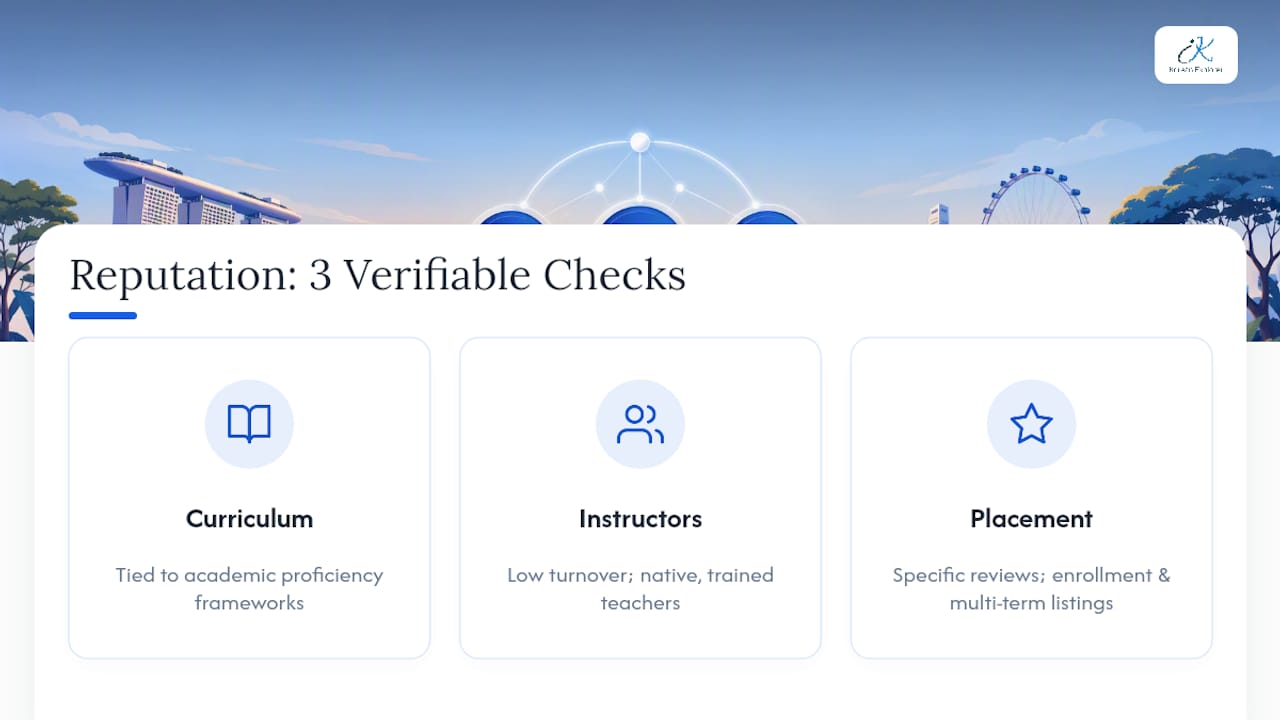
Reputation in this space isn’t about a single certificate on a wall. It comes down to three things you can actually verify before enrolling: how the curriculum is built, who’s teaching it, and how the school handles placement.
A school’s curriculum should trace back to a recognizable academic source rather than a generic in-house worksheet packet. Programs that align their course content with established proficiency frameworks tend to produce more consistent outcomes across cohorts, because every instructor is teaching toward the same measurable skill targets rather than improvising week to week.
Instructor turnover is another quiet signal. If a school can’t tell you how long their teaching staff has been with them, that’s often a sign of inconsistent quality between terms. Native-speaking instructors with formal teaching backgrounds, not just fluent friends hired casually, tend to explain grammar nuances more precisely and catch pronunciation errors that non-native reviewers miss entirely.
Student reviews and ratings matter, but read them for specifics. A review that says “great teacher, explained honorific speech levels clearly in week 6” tells you far more than a generic five-star rating with no detail. Look for patterns across multiple reviews rather than trusting a single glowing testimonial. Course listing platforms that show real enrollment numbers and consistent multi-term offerings over time are usually a safer bet than a school that appeared six months ago with no track record.
What Should You Expect From Instructors and Teaching Methods?
The instructor sitting in front of you matters more than the course brochure. Native Korean speakers who are also fluent in English bridge the gap between accurate pronunciation and clear grammar explanation, which matters enormously in the early stages when a single misplaced particle can flip a sentence’s meaning.
Teaching methodology splits roughly into two camps: grammar-translation heavy programs that drill textbook exercises, and conversation-focused programs that build speaking confidence through role-play and real dialogue from the first few sessions. For adult learners with limited weekly hours, conversation-focused methods tend to deliver usable skills faster, because you’re practicing the exact sentence patterns you’ll actually use at a Seoul airport counter or in a client email.
Good instructors also adjust pacing based on placement results instead of running every cohort through an identical script. If half your class already knows basic Hangul but struggles with sentence particles, a strong instructor restructures the first few weeks around that gap rather than repeating material some students don’t need. Ask during enrollment how instructors handle mixed-ability groups. Vague answers here usually mean a rigid, one-size-fits-all approach.
What Cultural Immersion Comes With a Korean Course?
Language and culture are hard to separate in Korean, where honorific speech levels change based on age, hierarchy, and context. Courses that weave cultural context into lessons rather than treating it as a side note tend to produce learners who sound more natural, not just grammatically correct.
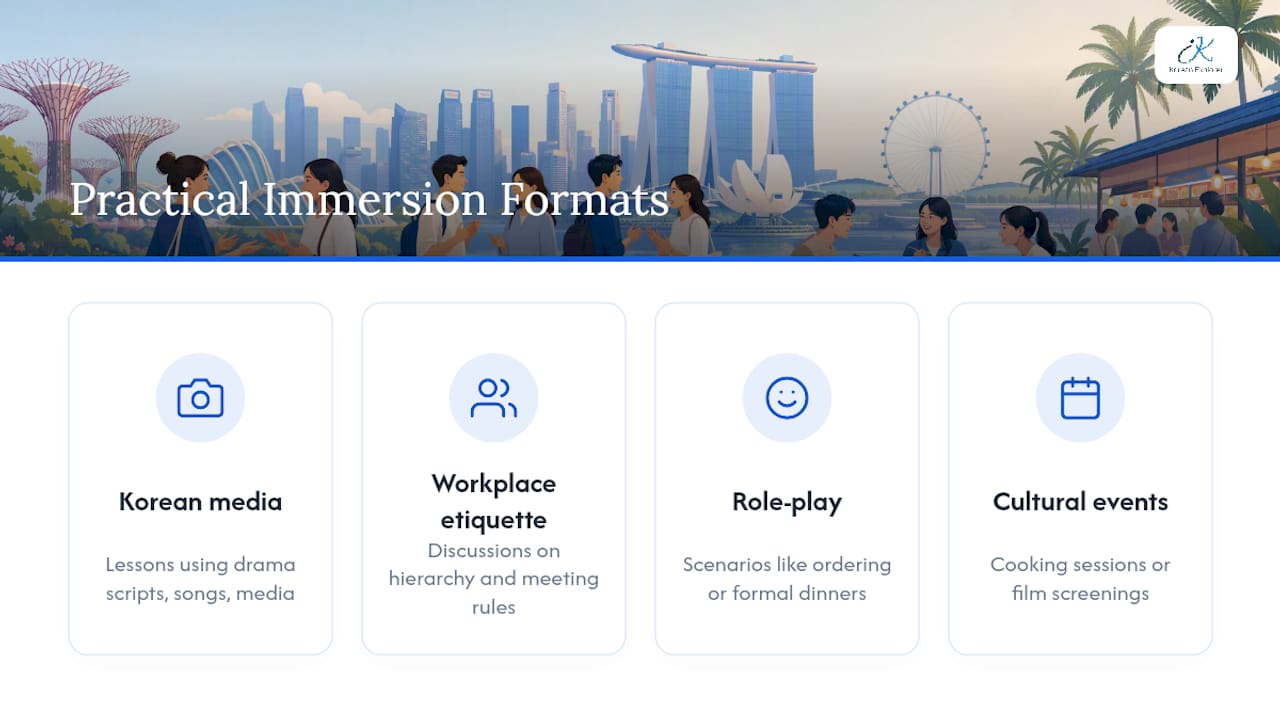
Practical immersion elements show up in several forms: lessons built around Korean media, drama scripts, or song lyrics that teach vocabulary through content learners already enjoy, discussions of workplace etiquette and social hierarchy that matter in real business settings, and role-play scenarios modeled on everyday situations like ordering at a café or navigating a formal dinner. Some programs also organize casual cultural events like Korean cooking sessions or film screenings that let students practice outside a structured lesson format.
For business-focused learners, cultural immersion extends into understanding meeting etiquette, how seniority affects speech level choices, and the unwritten rules around exchanging business cards or accepting a drink at a work dinner. These details rarely show up in a textbook but come up constantly in actual workplace interactions in Korea or with Korean colleagues locally.
What Supplementary Resources Should You Use Alongside Classes?
Classroom time alone rarely gets anyone to fluency. The learners who progress fastest treat class as the structure and fill the gaps with daily exposure outside it.
Apps like Naver Dictionary and mobile flashcard tools help with vocabulary retention between sessions, while structured workbooks reinforce grammar patterns covered in class. Korean variety shows, dramas with Korean subtitles, and podcasts aimed at intermediate learners build listening comprehension in a way that pure textbook study can’t replicate. Even Korean music works surprisingly well as a study tool, since repeated lyrics reinforce sentence patterns and pronunciation naturally.
Recorded lesson access, when a school offers it, is arguably the single most underused resource. Rewatching a session where a grammar point clicked, or reviewing a class you had to miss, closes gaps that homework alone doesn’t catch. Pair that with a habit of speaking out loud daily, even just narrating your commute in broken Korean, and progress compounds faster than classroom hours alone would suggest.
The Real Trade-Off Between Speed and Convenience
Regular group classes suit anyone who wants sustainable, social progress without burning out. Private or intensive tracks move faster, but they cost more and demand more weekly hours, which only works if your schedule genuinely has room for it. For most working adults, several months of steady group classes gets you to functional conversational ability. Skip the guesswork. Book a placement test first, so you start at the right level instead of relearning material you already know or drowning in content you’re not ready for.
— Paul
Ready to Start? Here’s How to Book Your First Lesson
Between regular term classes, private lessons, and live online Zoom sessions, Korean Explorer covers the format most working adults in Singapore are actually looking for: conversational and business Korean that fits around a job, not the other way around.
If you’re not sure where you’d land, a placement test clears that up in one short session rather than guessing your way into the wrong term. Courses run both in-person and through live Zoom classes with recorded access, so you can pick whichever fits your week better without giving up structure or native instructor feedback. The intermediate course track is a common next step for anyone who already has basic Hangul and grammar down and wants to move into fuller conversation and workplace communication.
The training center is located at 10 Anson Road, Level 22, International Plaza, Singapore 079903, right above Tanjong Pagar MRT. This is for anyone who prefers to visit or attend in person. Reach out to book a placement test or trial lesson, and get matched to the right starting level before your first paid term begins.
Where to Go Next
For comparing course options, fee ranges, and start dates across providers, MySkillsFuture’s course search is a useful starting reference. For direct course details and enrollment, visit Korean Explorer’s course listings to see current formats and schedules.
Sources
- MySkillsFuture | Search For korean language Courses
- In-Person Korean Classes for Adults – Korean American Center | King Sejong Institute
FAQ
How Much Do Korean Lessons Cost in Singapore?
Costs vary by format: group term courses are the most budget-friendly per hour, intensive courses cost more due to added weekly hours, and private lessons carry the highest per-hour rate but offer fully customized pacing. Checking course listings directly is the fastest way to compare current fee ranges across providers.
How Long Does It Realistically Take to Learn Korean?
Reaching functional conversational ability typically takes three to five regular terms, or roughly six months to a year of steady study at two to three hours of class per week plus homework. Intensive courses compress the calendar timeline but require significantly more weekly hours to cover the same material.
Where Can I Find Korean Tutors in Singapore?
Private tutors and one-on-one lessons are available through most established language schools, including Korean Explorer, which offers private and semi-private formats alongside group classes for adults wanting personalized pacing.
Where Can I Learn Korean Easily?
Combining structured group classes with a placement test to confirm your starting level is the most reliable path, since it avoids the frustration of being placed too high or too low. Pairing lessons with daily listening practice through Korean media speeds up comprehension noticeably within the first few months.