TL;DR:
- Structured Korean courses in Singapore boast higher success rates and clear progress benchmarks.
- Mastering Hangul and engaging consistently with native teachers accelerates beginner learning.
- Setting specific goals and practicing regularly help maintain motivation and measure progress toward fluency.
Many Singaporeans dive into Korean with genuine excitement, only to feel completely lost within weeks. Without a clear structure, most learners stall on pronunciation, skip foundational grammar, and eventually quit. In fact, structured courses help overcome the 90% dropout rate seen with unstructured self-study. That number is striking, but it also means success is very achievable when you follow the right path. This guide walks you through every critical step, from choosing your first class to tracking real progress, so you can build genuine Korean skills with confidence and stay motivated for the long term.
Table of Contents
- What you need to start beginner Korean lessons
- Step-by-step roadmap: How to succeed in beginner Korean
- Common pitfalls and how to overcome them
- How to know you’re making progress: Benchmarks and what comes next
- Making beginner Korean stick: Hard truths and fresh strategies
- Try a proven beginner Korean lesson in Singapore
- Frequently asked questions
Key Takeaways
| Point | Details |
|---|---|
| Structure matters most | Enrolling in a structured course with native teachers drastically increases your chance of reaching basic proficiency. |
| Focus on real use | Prioritize speaking practice, cultural exposure, and regular feedback for the fastest and most durable learning. |
| Track your gains | Benchmarks like TOPIK I and CEFR A1–A2 help you measure progress and stay motivated even after the first term. |
| Avoid beginner pitfalls | Skipping Hangul or relying on solo apps are the leading causes of frustration and slow advancement. |
What you need to start beginner Korean lessons
Before you sign up for anything, it helps to know exactly what you’re getting into. The good news is that the barrier to entry is lower than most people think.
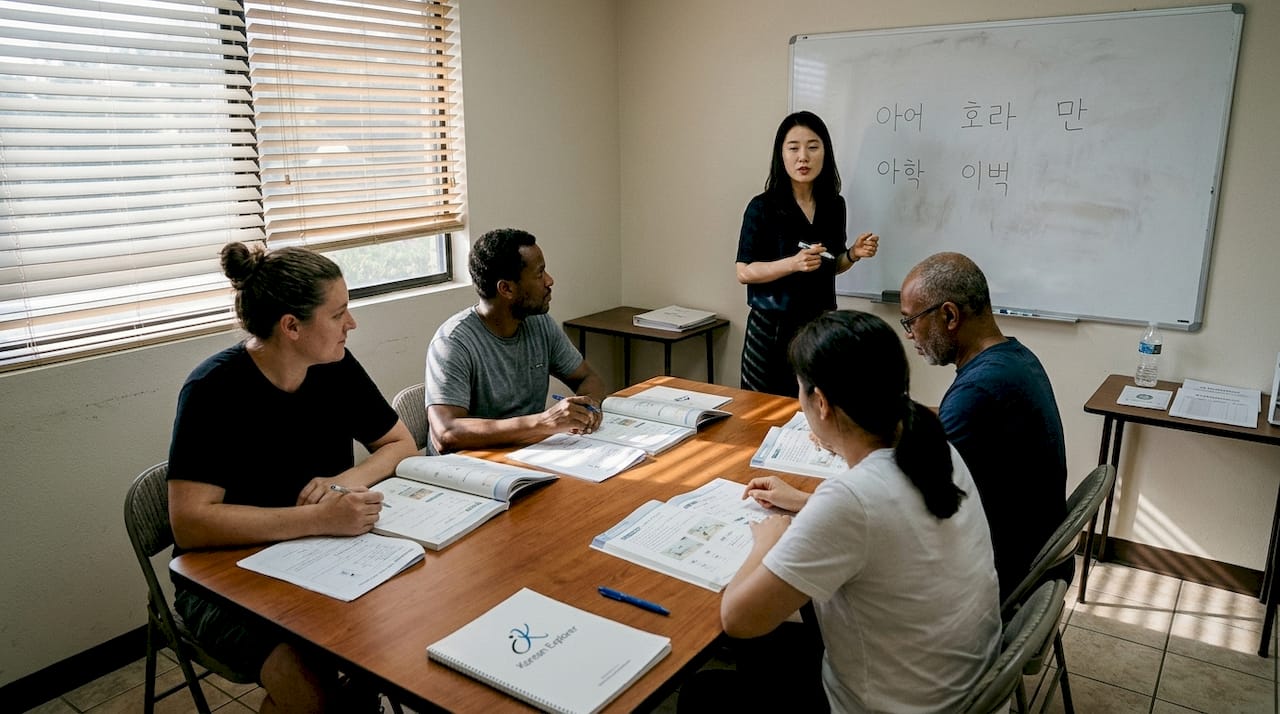
Most structured beginner Korean courses in Singapore span 8-12 weeks, cost S$240-400 per term, and have 6-15 students per class. That range covers both budget-conscious learners and those who want a more personalized setting. Materials are usually included or cost under S$30 extra.
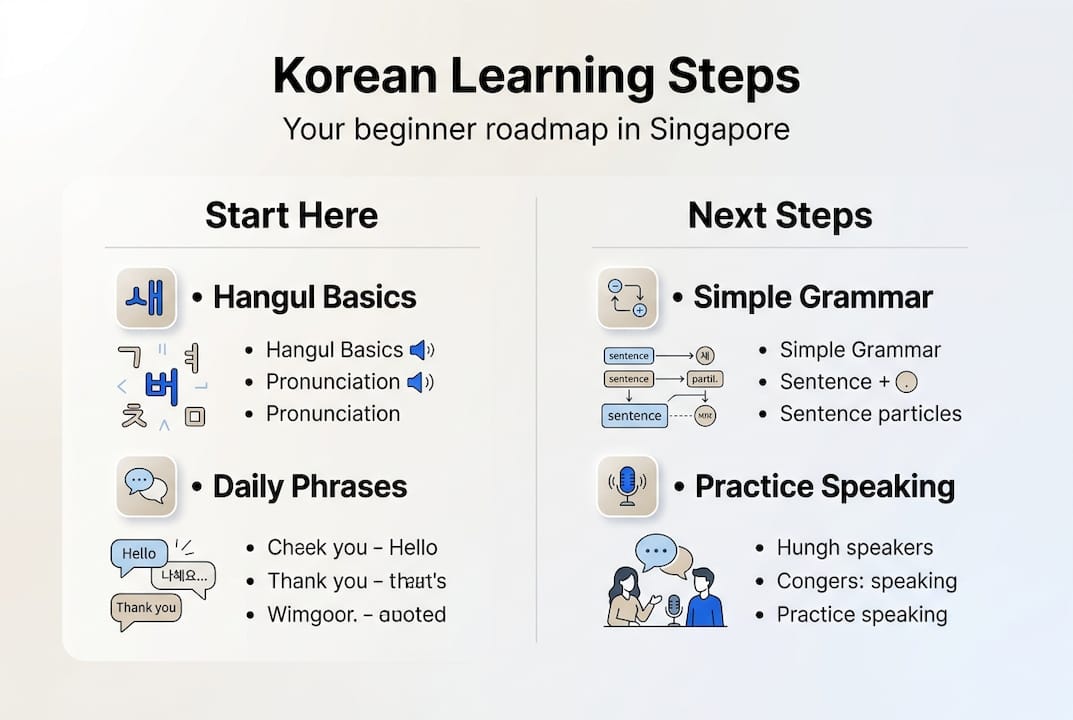
Here’s what a typical beginner curriculum covers:
- Hangul (the Korean alphabet): reading and writing the 24 core letters and syllable blocks
- Basic greetings and introductions: how to say hello, introduce yourself, and respond politely
- Daily phrases: ordering food, asking directions, and basic small talk
- Foundational grammar: sentence structure, particles, and verb endings
- Cultural basics: honorifics, social context, and why formality matters in Korean
Most reputable schools align their beginner content to the CEFR A1-A2 framework (the Common European Framework of Reference for Languages) and to TOPIK I standards. TOPIK, which stands for Test of Proficiency in Korean, is Korea’s official language proficiency exam recognized by universities and employers worldwide. Knowing your course maps to these benchmarks means your progress has real, transferable value.
Choosing where to take Korean classes matters just as much as what you study. A structured classroom environment gives you immediate correction and social accountability. Self-study apps, by contrast, have no mechanism to catch bad pronunciation habits early. If you want to learn Korean in Singapore efficiently, a school with a clear syllabus beats app-hopping every single time.
| Feature | Structured course | Self-study app |
|---|---|---|
| Pronunciation feedback | Immediate from teacher | Automated or none |
| Grammar correction | Real-time | Delayed or generic |
| Cultural context | Taught explicitly | Rarely included |
| Accountability | Built-in via schedule | Entirely self-driven |
| Progress benchmarks | TOPIK/CEFR aligned | Gamified points only |
Pro Tip: Prioritize classes led by native Korean teachers. They catch pronunciation errors that non-native teachers often miss, and they bring authentic cultural context into every lesson.
Step-by-step roadmap: How to succeed in beginner Korean
Now that you know what’s involved, let’s break down your ideal path step by step.
- Enroll in a structured course with a clear syllabus, small class sizes, and TOPIK-aligned content.
- Master Hangul first. This takes most learners 1-2 weeks with proper instruction. Syllable-block Hangul teaching outperforms letter-by-letter methods, and small class sizes enable twice-as-fast progress with feedback and role-play.
- Attend every class consistently. Missing even one session in a tightly sequenced beginner course creates gaps that are hard to recover from.
- Review material within 24 hours of each class. Spaced repetition (reviewing content at increasing intervals) dramatically improves retention.
- Practice speaking out loud between sessions. Whisper-reading vocabulary, recording yourself, or chatting with a classmate all count.
- Leverage teacher feedback actively. Ask questions about pronunciation. Request correction during speaking exercises. Feedback is the fastest shortcut to accuracy.
- Set small weekly goals. Aim to memorize 10 new vocabulary words, complete one writing exercise, or hold a 2-minute conversation each week.
When choosing your learning format, the right fit depends on your schedule and learning style. Here’s a quick comparison:
| Format | Best for | Pace | Interaction |
|---|---|---|---|
| Group class (onsite) | Social learners, budget-conscious | Structured | High |
| Private class | Flexible schedules, fast-trackers | Customizable | Intensive |
| Online class | Remote learners, busy professionals | Flexible | Moderate |
| University extension | Academic credit seekers | Semester-based | Moderate |
| Private language school | Focused skill-building | Term-based | High |
For most beginners in Singapore, group classes at a reputable private school offer the best balance. Review this structured Korean learning guide for a deeper breakdown of each option, and check where to learn Korean for location-specific choices across the island.
Pro Tip: Watch a K-drama episode or listen to a K-pop song immediately after class. When your brain is already in Korean mode, it picks up new vocabulary and natural speech patterns much faster. Use it as a reward that doubles as practice.
Common pitfalls and how to overcome them
Even with a great plan, it’s easy to stumble. Here’s how to avoid the mistakes most beginners make.
The most common traps that derail Korean learners:
- Skipping Hangul entirely. Some beginners try to learn Korean using romanized text (writing Korean sounds with English letters). This creates permanent pronunciation problems and slows reading speed significantly. Invest the first two weeks in Hangul. It pays back tenfold.
- Not practicing speaking. Reading vocabulary silently is passive learning. Korean has sounds that don’t exist in English or Mandarin, and you only build those muscle patterns by speaking out loud.
- Underestimating spoken Korean. Written and spoken Korean differ. Formal speech, casual speech, and the abbreviated forms used in everyday conversation are distinct registers. Real-life immersion accelerates your ear for these differences.
- Platform hopping. Switching between apps, YouTube channels, and random textbooks without a sequence fragments your learning. Each resource teaches different vocabulary at different levels, leaving gaps.
- No clear goals. “Learn Korean” is not a goal. “Pass TOPIK I by the end of the year” is. Specific targets keep you honest about progress.
“The 90% dropout rate in unstructured learning isn’t about intelligence or effort. It’s about the absence of clear progression, real feedback, and native-speaker context. When those three elements are present, the success rate flips dramatically.” Source: Structured Korean Learning Helps Singaporeans Achieve Fluency
Time management is also real. Most adult learners in Singapore have full-time jobs or studies. Two to three hours of structured class time per week, plus 30 minutes of daily review, is enough to complete a beginner level in one term. You don’t need to overhaul your life. You just need consistency.
Curious about learning Korean from K-dramas? It works as a supplement, not a replacement. And if you want a realistic picture of commitment, read up on what it takes to learn Korean as a Singaporean adult.
How to know you’re making progress: Benchmarks and what comes next
Finally, you need a way to see how far you’ve come and plan your next move.
Progress without a benchmark is just guesswork. Two recognized standards matter most for beginners:
- CEFR A1: You can introduce yourself, ask simple questions, and understand slow, clear speech on familiar topics.
- CEFR A2: You can handle basic social exchanges, describe your routine, and read short simple texts.
- TOPIK I (Levels 1-2): Korea’s official beginner proficiency certification. TOPIK I validates beginner progress and is preferred by leading schools for academic and professional objectives.
Practical self-checks you can use right now, even before taking a formal test:
- Can you read a Hangul sign out loud without sounding it out letter by letter?
- Can you greet someone, introduce yourself, and respond to a basic question entirely in Korean?
- Can you write a 3-sentence description of your daily routine?
- Can you count objects, tell the time, and ask for the price of something?
If you can do all four, you’re solidly at A1 and ready to push toward A2.
Statistic callout: Courses aligned with TOPIK and CEFR standards give learners a measurable edge for university applications and Korean workplace environments where language credentials are increasingly valued.
Once you clear beginner level, the path opens up significantly. Intermediate classes introduce more complex grammar, written Korean, and formal business register. Cultural exchanges, language partner programs, and even short-term study visits to Korea become realistic. Check out this Korean expert guide for a full roadmap of what comes after beginner level.
Making beginner Korean stick: Hard truths and fresh strategies
Here’s what experience shows actually works for busy adults in Singapore.
Most people assume language apps are a harmless starting point. They’re not. Apps are engineered for engagement, not fluency. They reward streaks, not accuracy. By the time a learner realizes they’ve been practicing the same 50 words for three months without progressing, they’re already discouraged.
The real game-changer is structured, social learning that outperforms apps or solo study. Blending group feedback, Korean media, and native conversation is what actually moves the needle. Even shy learners benefit enormously from group settings because the pressure to speak in front of peers, while uncomfortable at first, is exactly what builds real fluency. Accountability to a class schedule and a teacher is not a constraint. It’s the mechanism.
The learners who stick with Korean long-term in Singapore are not the ones with the most free time. They’re the ones who learn Korean inside a structure that makes skipping feel like a loss rather than a relief.
Pro Tip: After your first few weeks of class, form a small practice group with two or three classmates. Meet once a week outside of class to review vocabulary, do role-play exercises, or just chat in Korean. This peer accountability makes a measurable difference in retention.
Try a proven beginner Korean lesson in Singapore
Ready to turn your first steps into real progress? Here’s how you can start today.
Korean Explorer offers beginner classes built on a Seoul National University curriculum and aligned to TOPIK standards, taught by experienced native Korean instructors at centers in Tanjong Pagar, Jurong, and Tampines. Whether you prefer group or private lessons, onsite or online, there’s a format that fits your schedule.
Browse available Korean language courses to find a class that fits your level and schedule. If you’re planning to use your course for career development, explore options under SkillsFuture Korean language funding. Ready to commit? View all Korean courses and take the first concrete step toward real fluency today.
Frequently asked questions
How long does it take to complete a beginner Korean course in Singapore?
Beginner Korean courses in Singapore typically take 8-12 weeks per level, covering all the core foundations you need before moving to intermediate content.
What will I learn as a beginner Korean student?
Beginner courses teach Hangul, greetings, daily phrases, and basic grammar following CEFR A1-A2 standards, giving you practical conversational skills from day one.
Are native Korean teachers necessary for beginners?
Native teachers are highly recommended for beginners because they provide accurate pronunciation models and real-life cultural context that non-native teachers cannot fully replicate.
Should I choose group classes or private lessons to start?
Group classes foster interaction and faster progress through peer feedback, while private lessons suit learners who need a more flexible pace or highly customized content.
What is TOPIK and should beginners care about it?
TOPIK I validates beginner progress at levels 1-2 and is recognized by schools and employers in Korea and internationally, making it a worthwhile goal even from your very first term.