TL;DR:
- Structured Korean courses significantly increase the likelihood of achieving fluency for adult learners.
- Teaching Hangul using syllable blocks and introducing grammar systematically are key to faster progress.
- Combining in-person or online classes with regular practice and benchmarks like TOPIK enhances language mastery.
Most people who try to learn Korean on their own quit before they ever hold a real conversation. The 90% dropout rate in self-study programs is striking, but it makes sense once you understand why structure matters so much in language acquisition. Korean is not just a new vocabulary set layered over English grammar. It has a completely different sentence order, a unique writing system, and a layered honorific system that changes how you speak depending on who you are talking to. For Singaporean learners aged 16 and above, a structured Korean course does not just speed up learning. It makes fluency actually achievable.
Table of Contents
- How Korean language courses in Singapore are structured
- Which teaching methods actually work (and why)
- Choosing between online and in-person Korean lessons
- Benchmarks, tests, and real-world Korean communication
- The most common mistakes Korean learners make (and what actually works)
- Start your structured Korean learning journey
- Frequently asked questions
Key Takeaways
| Point | Details |
|---|---|
| Structure beats self-study | Enrolling in organized Korean courses yields far better retention than trying to learn alone. |
| Method matters most | Syllable-based instruction and clear grammar explanations speed up real-world language use. |
| Multiple formats help | Blending in-person feedback with online flexibility supports rapid, lasting progress. |
| Set clear goals | Benchmarks like TOPIK guide your development and open academic or professional doors. |
How Korean language courses in Singapore are structured
Understanding what “structured learning” really means is the first step to choosing the right course. In Singapore, Korean language courses for adults follow the CEFR (Common European Framework of Reference for Languages) model, which organizes proficiency into six levels from A1 (complete beginner) to C2 (mastery). This framework gives you a clear roadmap from day one.
At the A1 and A2 levels, you focus on Hangul (the Korean alphabet), basic greetings, numbers, and everyday phrases like ordering food or asking for directions. By B1 and B2, you are handling longer conversations, reading short texts, and navigating social situations with confidence. At C1 and C2, you can participate in professional discussions, write formal documents, and debate complex topics in Korean.
Courses in Singapore are typically offered in several formats to suit different lifestyles:
- Group classes (usually 8 to 15 students) for structured peer interaction
- Private lessons for personalized pacing and focused feedback
- Online classes for flexibility around work or school schedules
- Exam preparation courses specifically aligned with TOPIK standards
You can also explore where to take Korean classes across different parts of Singapore, including central, Jurong, and Tampines locations.
Here is a quick overview of what to expect at each stage:
| Level | CEFR stage | Focus areas | Typical duration |
|---|---|---|---|
| Beginner | A1 to A2 | Hangul, greetings, daily phrases | 10 to 11 weeks per level |
| Intermediate | B1 to B2 | Conversations, grammar, reading | 10 to 11 weeks per level |
| Advanced | C1 to C2 | Professional use, debate, writing | 10 to 11 weeks per level |
Course fees typically range from S$315 to S$360 per term depending on the level and format. For a full breakdown, the course structure details page covers everything you need to compare options. Some institutions like NTU also offer Korean language programs, giving learners in Singapore a range of institutional choices.
Which teaching methods actually work (and why)
Not all Korean courses teach the same way, and the difference in method has a real impact on how fast you progress. Two areas stand out as especially important: how Hangul is taught and how grammar is sequenced.
Hangul looks intimidating at first, but it is actually a highly logical writing system. The key question is whether your course teaches it letter by letter (grapheme instruction) or block by block (syllable instruction). Research shows that syllable-based Hangul instruction produces higher reading accuracy on both familiar and new words compared to grapheme-based approaches, especially for English-speaking adults. This matters because English speakers are wired to decode words letter by letter. Syllable blocks in Korean work differently, and learning them as units from the start rewires your reading instinct correctly.
Here is a comparison of the two approaches:
| Instruction type | How it works | Best for |
|---|---|---|
| Grapheme (letter-by-letter) | Teaches each consonant and vowel separately | Familiar to English speakers initially |
| Syllable (block-based) | Teaches consonant-vowel combinations as units | Faster reading fluency and accuracy |
Beyond Hangul, grammar sequencing matters enormously. Korean uses a subject-object-verb (SOV) sentence structure, which is the opposite of English. Add in verb endings that change based on tense, politeness level, and formality, and you can see why a random approach to grammar causes confusion fast. Good courses introduce verb endings systematically and explain honorifics (the formal and informal speech levels) in context, not as an afterthought.
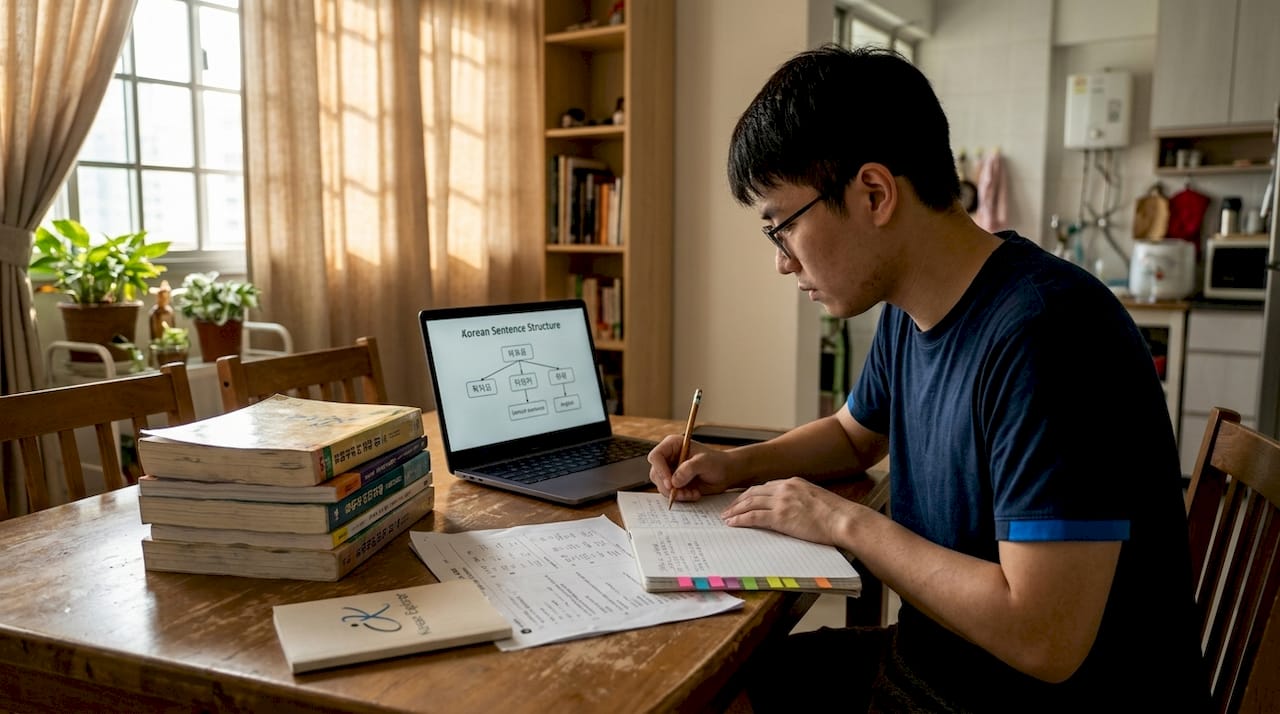
Cultural immersion also plays a real role in structured learning. Integrating K-pop lyrics, K-drama dialogues, and real-world scenarios into lessons connects grammar rules to living language. This is not just motivating. It builds the kind of pattern recognition that makes Korean stick. You can find language schools in Singapore that blend cultural content with structured curriculum effectively.
Pro Tip: When evaluating a Korean course, ask specifically whether Hangul is taught using syllable blocks and whether grammar patterns are introduced in a clear sequence. These two factors alone will tell you a lot about the quality of the program.
Choosing between online and in-person Korean lessons
Once you know what a good Korean course looks like, the next decision is how you want to attend it. Both online and in-person formats have real advantages, and the right choice depends on your schedule, learning style, and goals.
In-person classes give you immediate feedback from a native instructor, real-time pronunciation correction, and the social energy of a classroom. For learners who struggle with self-motivation, showing up physically to a class creates accountability that is hard to replicate at home. The structured environment also means you are less likely to skip sessions or fall behind.
Online classes offer flexibility that suits busy professionals and students in Singapore. You can join from anywhere, save commute time, and often access recorded sessions for review. Costs can also be lower in some formats.
Here is a quick breakdown:
- In-person strengths: Real-time feedback, pronunciation coaching, peer interaction, structured accountability
- Online strengths: Flexible scheduling, no commute, accessible from home or office, often more affordable
- Both formats: Structured curriculum, native instructors, TOPIK-aligned content
The critical point is that structured learning dramatically outperforms self-study, regardless of the delivery format. Apps and YouTube videos spark interest, but without consistent feedback and a logical learning sequence, most learners plateau quickly. You can compare online vs in-person options to find what fits your lifestyle, or review the full detailed course breakdown to see what each format includes.
Pro Tip: If your schedule is unpredictable, consider a blended approach where you attend in-person classes for core grammar and pronunciation, then use online resources to practice vocabulary and listening between sessions. This combination tends to produce the fastest results.
Benchmarks, tests, and real-world Korean communication
Learning Korean without a clear progress benchmark is like training for a race without knowing the distance. Benchmarks keep you honest, motivated, and focused on the right skills at the right time.
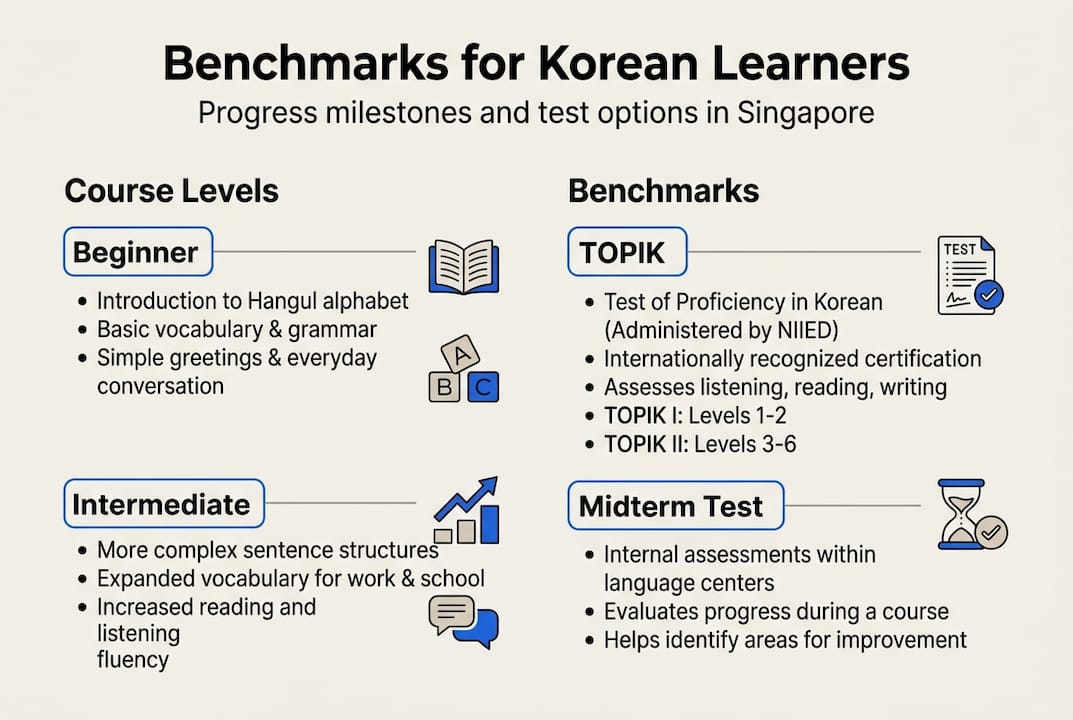
The most recognized benchmark for Korean is the TOPIK (Test of Proficiency in Korean). It is a standardized exam accepted by universities and employers in South Korea and increasingly recognized in Singapore’s professional landscape. TOPIK I covers levels 1 and 2 (beginner), while TOPIK II covers levels 3 through 6 (intermediate to advanced). Passing TOPIK is often required for university admission in South Korea and for certain professional roles. Research on Korean proficiency measures confirms that TOPIK remains the primary standard for academic and professional communication goals.
Another useful tool is LexKO, a vocabulary-based proficiency check that gives you a quick snapshot of where your Korean stands without the formality of a full exam. Think of it as a diagnostic tool between TOPIK sittings.
“Korean grammar presents unique challenges for English speakers, including SOV sentence structure, silent letters, and multiple honorific levels that change the entire tone of a conversation.”
Here is a practical roadmap from beginner to real-world communication:
- Master Hangul using syllable-based instruction (typically 1 to 2 weeks in a structured course)
- Build A1 vocabulary around daily situations: food, transport, shopping, introductions
- Learn core grammar patterns including basic verb endings and present/past tense
- Practice speaking in structured drills and real conversations with a native instructor
- Advance to B1 by tackling longer texts, listening exercises, and polite speech forms
- Prepare for TOPIK with exam-specific practice and timed writing tasks
For Singapore-based learners, you can find TOPIK preparation options that align with this roadmap and give you a structured path to certification.
The most common mistakes Korean learners make (and what actually works)
Here is something most Korean learning content will not tell you directly: enthusiasm is not a strategy. Many learners in Singapore start with genuine motivation, binge K-dramas, download apps, and feel like they are making progress. Then, around week six, the grammar gets harder, the honorifics get confusing, and without structured feedback, they quietly stop.
The pattern is consistent: self-study fuels early excitement but rarely builds the feedback loops needed for real fluency. Media consumption is valuable, but it is not a substitute for a teacher who can tell you why your sentence sounds unnatural.
Another underestimated mistake is skipping Hangul instruction and jumping straight to romanized Korean. Romanization creates a pronunciation ceiling you will hit fast. Learning Hangul properly through syllable blocks, as covered in the K-wave motivation context, removes that ceiling entirely.
What actually works is a combination of structured classes, consistent review, and deliberate speaking practice. Not cramming vocabulary lists. Not passive listening. Guided, corrected, progressive practice with a native speaker who understands how English speakers think.
Start your structured Korean learning journey
If this article has made one thing clear, it is that the path from curious beginner to confident Korean speaker is well-defined. You do not need to figure it out alone.
Korean Explorer offers Korean language courses from complete beginner to advanced levels, including TOPIK preparation, all taught by experienced native instructors using a Seoul National University curriculum. If you are eligible for government funding, SkillsFuture Korean classes make structured learning even more accessible. Already past the basics? The intermediate Korean course is designed to push your conversational ability to the next level. With centers at Tanjong Pagar, Jurong, and Tampines, getting started has never been more convenient.
Frequently asked questions
How long does it take to learn basic Korean in Singapore?
Most adult learners reach A1 level in 10 to 11 weeks with a structured course, with fees typically ranging from S$315 to S$360 per term.
Is self-study effective for learning Korean?
Self-study alone is linked to a 90% dropout rate, while structured classes with regular feedback build the consistency needed for real fluency.
What is the TOPIK exam and why is it important?
TOPIK is a standardized Korean proficiency test used for university and career applications, and it is widely recognized by academic institutions and employers in South Korea and beyond.
Does learning Hangul syllable-by-syllable help English speakers?
Yes. Syllable-based instruction produces higher reading accuracy on both trained and new words compared to letter-by-letter methods, making it the more effective approach for English-speaking adult learners.