TL;DR:
- Understanding Korean culture is essential for effective communication and social harmony.
- Proper etiquette and social awareness help learners avoid misunderstandings and build genuine connections.
- Balancing language skills with cultural fluency, especially through practice and social intelligence, accelerates mastery.
Learning Korean without understanding its culture is like memorizing song lyrics without knowing the melody. Many Singaporean learners arrive at their first Korean conversation confident in their vocabulary, only to freeze when a colleague waits for them to pour a drink or an elder pauses expecting a bow. These moments reveal a gap that textbooks rarely close. Korean culture, with its layered social rules and deep Confucian roots, shapes every sentence you speak. This guide walks you through the cultural knowledge, practical tools, and real-life scenarios you need to not just speak Korean, but to connect meaningfully with Koreans around you.
Table of Contents
- Why cultural understanding is crucial for Korean learners
- What you need: Essential etiquette, tools, and resources
- How to apply Korean etiquette and language in real life
- Common pitfalls and how to verify your cultural fluency
- What most guides miss: The art of balance and nunchi
- Take the next step in your Korean culture journey
- Frequently asked questions
Key Takeaways
| Point | Details |
|---|---|
| Culture and language are linked | Understanding Korean culture is essential for using the language effectively in real conversations. |
| Etiquette impacts success | Simple actions like bowing, using two hands, and speech levels shape relationships and opportunities. |
| Practical experience matters | Applying etiquette in real scenarios helps you internalize both language and social norms. |
| Test your skills | Placement tests and the TOPIK exam can measure both your language and cultural proficiency. |
Why cultural understanding is crucial for Korean learners
Language and culture are inseparable in Korean. Every sentence you form carries a social signal, whether you realize it or not. The word you choose to say “eat” to a friend differs from the one you use with your boss, and getting this wrong can feel rude even if your grammar is technically perfect.
“Language is not just a communication tool. In Korean, how you speak signals who you are and how you see others.”
This is especially true because of Korea’s Confucian values, which place enormous weight on hierarchy, seniority, and group harmony. These values are baked into everyday interactions, from how you greet someone to how you sit at a dinner table. Missing these cues can lead to social awkwardness or, in professional settings, lost opportunities.
Here is why culture fluency matters so much for Korean learners:
- Speech levels reflect status. Korean has 7 speech levels shaped by Confucian influence, and learners must choose the right level every time they speak.
- Indirectness is a core communication style. Koreans often say “it might be a little difficult” when they mean “no.” Reading between the lines is essential.
- Nonverbal cues carry as much weight as words. Eye contact, posture, and how you hand over items all communicate respect or disrespect.
- Group identity shapes language choices. Who you are relative to the group you are speaking with determines everything.
Modern Korea has evolved, especially among younger generations in Seoul, but etiquette remains vital. You might see friends speaking casually over street food, but in a workplace or at a family gathering, traditional expectations resurface instantly.
If you want a solid foundation for navigating all of this, our practical guide to Korean fluency explains how cultural awareness speeds up language progress. For Singaporeans just starting out, learning Korean in Singapore has become significantly more accessible, and pairing structured learning with cultural education is the most effective path forward.
What you need: Essential etiquette, tools, and resources
Before you can apply Korean cultural knowledge, you need to know the basics. Think of these as non-negotiable starting points that every learner should understand in the first weeks of study.
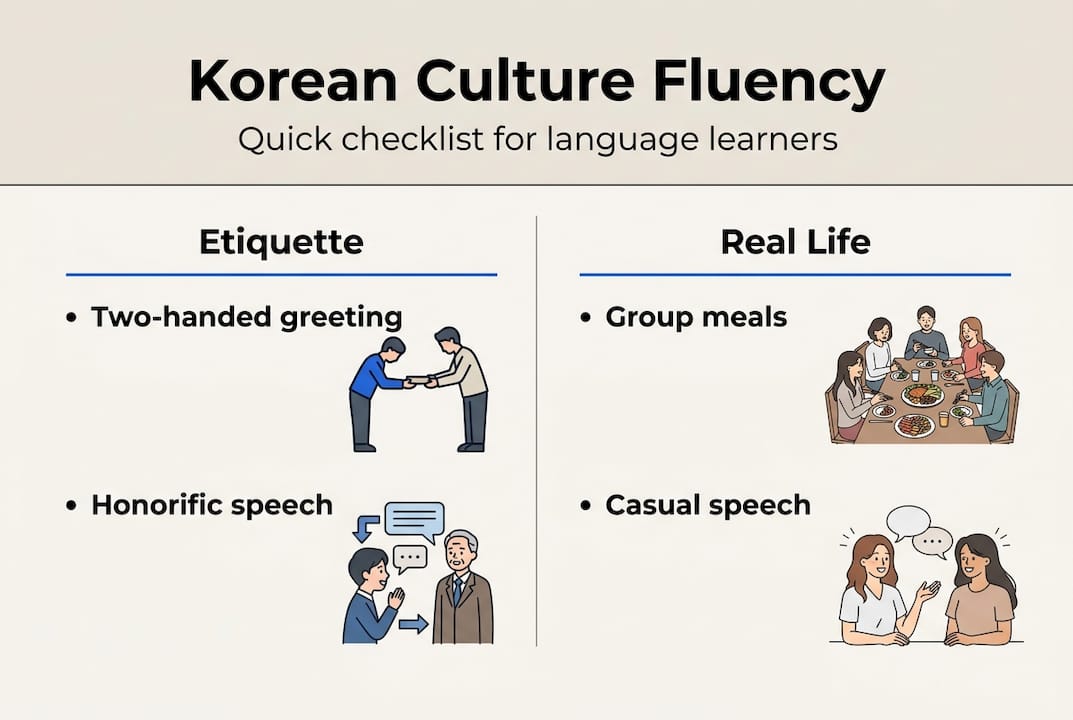
First, the core etiquette mechanics. According to standard Korean social practice, you should remove shoes indoors, bow when greeting someone older or senior, and always use two hands when giving or receiving objects. These three habits alone will earn you immediate goodwill in most Korean settings.
Here is a quick reference of must-know etiquette areas:
- Greetings: Bow slightly with a nod for casual greetings; a deeper bow for elders or formal occasions
- Dining: Wait for the eldest person to eat first; never pour your own drink; offer to refill others’ glasses
- Shoes: Always remove shoes before entering a Korean home
- Both hands: Use two hands when presenting business cards, gifts, or payment
- Silence: Silence at the dinner table is comfortable, not awkward. Avoid forcing conversation.
| Resource type | Examples | Cost range |
|---|---|---|
| Language apps | Duolingo, Pimsleur, Anki | Free to S$30/month |
| Online courses | TTMIK, How to Study Korean | Free to S$50 |
| Local classes | Korean Explorer, Sejong Institute | S$300 to S$500 per term |
| Cultural guides | Korean culture tips, Seoul tourism site | Free |
For Singaporean learners, local classes stand out because many integrate cultural modules directly into lessons. Exploring language learning resources in Singapore gives you a clear view of what is available across formats. If your schedule is tight, our Korean online learning guide covers flexible study options that still include cultural instruction.

Pro Tip: Look for courses where the instructor explains not just what to say, but why. Cultural context embedded in language lessons sticks far better than etiquette rules memorized separately.
How to apply Korean etiquette and language in real life
Knowing the rules is one thing. Applying them confidently in a real conversation, business meeting, or dinner is another. Here is a step-by-step process to help you move from theory to practice.
- Start with greetings. Use 안녕하세요 (annyeonghaseyo) in most situations. Save 안녕 (annyeong) for close friends your age or younger. When in doubt, go formal.
- Address people correctly. Use 씨 (ssi) after a full name for polite address. Avoid using first names alone unless invited to do so.
- Match your speech level to the relationship. Korean speech levels include formal, polite, and casual registers that learners need to navigate daily.
- At the dining table, observe before acting. Let the senior person begin eating. Fill others’ glasses before your own. Accept food with two hands.
- Read the room constantly. This is the practice of nunchi, a form of social awareness that Koreans value deeply. Notice the energy, adjust your tone, and avoid oversharing.
| Scenario | Traditional response | Modern/casual response |
|---|---|---|
| Meeting a senior colleague | Deep bow, formal speech level | Slight bow, polite speech level |
| Receiving a gift | Accept with two hands, open later | Accept with two hands, may open now |
| Dining with elders | Wait, pour for others first | Still wait, but atmosphere is relaxed |
| Addressing a classmate | Use full name plus 씨 | First name or nickname acceptable |
For a deeper look at how these scenarios fit into a broader study plan, the structured language guide from Korean Explorer connects cultural practice with grammar milestones effectively. You can also check the Seoul Korean etiquette guide for scenario-specific guidance directly from Seoul’s official tourism resource.
Pro Tip: Nunchi is not just about being polite. It is about knowing when to speak, when to stay quiet, and when to act. Practicing this skill in everyday life, even before you are fluent, will make you stand out as a culturally aware speaker.
Common pitfalls and how to verify your cultural fluency
Even dedicated learners make predictable mistakes. Knowing what they are helps you avoid them faster.
Common cultural missteps include:
- Using the wrong speech level by defaulting to casual Korean with someone older or senior
- Interrupting elders during conversation, which signals disrespect regardless of intent
- Pouring your own drink at a group meal, which is considered impolite in most contexts
- Missing nonverbal cues like an elder’s pause that signals they want you to slow down
- Skipping the bow in formal or first-time meeting situations
To check your progress, go beyond vocabulary tests. Do mock roleplays with a partner or instructor. Simulate a workplace introduction, a dinner with elders, or a casual meetup with peers. Ask for direct feedback on your speech level choices, not just your grammar.
For self-study, our home study guide includes checkpoints for cultural fluency alongside language milestones. If you want a formal baseline, a Korean placement test can reveal where your understanding stands relative to international benchmarks.
Speaking of benchmarks, the TOPIK exam is the gold standard. 550,000 people sat for TOPIK in 2025, a record driven by the global Hallyu wave. This surge reflects a huge global community of learners you are part of. TOPIK levels 1 through 6 align broadly with the CEFR framework, giving you a recognized credential that means something in Korean academic and professional environments. Aiming for TOPIK Level 3 or above demonstrates that you can handle real-world cultural and linguistic situations, not just classroom exercises.
Connect with Korean-speaking communities in Singapore, attend cultural events, and use every interaction as a live practice session. Growth shows up in conversations before it shows up on tests.
What most guides miss: The art of balance and nunchi
Most etiquette guides treat Korean culture as a fixed rulebook. Memorize the bowing angles. Learn the speech levels. Follow the table manners. Done. But that framing misses the most important skill: adaptability.
At Korean Explorer, we have seen Singaporean learners who recite every rule correctly but still feel awkward in real Korean conversations. The reason is usually nunchi. This quiet social intelligence, the ability to read a room and respond to its unspoken rhythm, is what separates technically correct speakers from genuinely confident ones.
Young Koreans in Seoul today are more relaxed than the rulebooks suggest. Formality fades faster in casual settings. Foreigners are often given genuine goodwill if they make a visible effort. What Koreans notice most is not perfection. It is awareness and sincerity.
For Singaporeans specifically, cultural adaptability is a natural strength. Many of you already navigate multiple cultural registers daily. Applying that same instinct to Korean contexts can accelerate your progress significantly. Our insights for Singaporean learners explore this intersection in detail. Trust your social instincts. The rules are a foundation, not a ceiling.
Take the next step in your Korean culture journey
You now have the framework, the tools, and the real-life strategies to move forward as a culturally aware Korean speaker. The next step is putting it into practice with guidance that connects language and culture in every lesson.
At Korean Explorer, our Korean language courses are built on a Seoul National University curriculum that naturally weaves cultural understanding into every stage of learning. Whether you are preparing for TOPIK test information or simply want to feel confident in your next Korean conversation, our native instructors and flexible class formats make real progress achievable. Join learners across Singapore who are building not just fluency, but genuine cultural connection.
Frequently asked questions
Do I need to use honorifics with everyone in Korea?
Honorifics, called jondaetmal, should be used with elders, superiors, or in formal settings, but peers or close friends of similar age may shift to casual speech once a relationship is established.
What are the most common etiquette mistakes by Singaporean learners?
Common mistakes include skipping the two-handed greeting, pouring your own drink at group meals, and not recognizing seniority within a group. The Seoul etiquette guide recommends always using two hands when giving or receiving as a reliable baseline.
How can I test my Korean cultural and language skills in Singapore?
You can take the TOPIK exam levels 1 to 6, use a local Korean placement test, or enroll in courses that include structured cultural assessment alongside language evaluation.
Is Korean culture strict about etiquette with foreigners?
Korean etiquette has traditionally high standards, but foreigners who demonstrate awareness and genuine effort are met with encouragement rather than judgment. Sincerity matters more than perfection in most real-world encounters.
Are there affordable ways to learn Korean culture in Singapore?
Yes. Free tools like TTMIK and How to Study Korean offer cultural context alongside language lessons, and local classes from S$360 for 12 sessions provide structured instruction with cultural integration built in.