TL;DR:
- Curriculum alignment ensures Korean courses meet South Korea’s national standards for comprehensive skill development.
- Spiral learning and clear achievement benchmarks foster deeper mastery and real conversational fluency.
- Well-structured programs with recognized standards significantly improve learning outcomes and test success.
Signing up for a Korean class feels like progress. But many learners in Singapore hit a wall months in, still struggling to hold a real conversation despite completing several course books. The problem is rarely effort. It’s structure. When a course lacks alignment with recognized Korean language standards, learners end up with patchy skills, gaps in grammar, and no clear path forward. Structured learning in Singapore changes that equation entirely. This guide breaks down what Korean curriculum alignment actually means, how it works in practice, and why it’s the single most important factor in moving from beginner frustration to genuine fluency.
Table of Contents
- Defining Korean curriculum alignment: standards and competencies explained
- How the Korean curriculum is structured: spiral learning and achievement path
- Curriculum alignment in practice: adaptation for Singaporean learners and proficiency tests
- The link between curriculum alignment, assessment, and real fluency
- Nuances, edge cases, and what to watch for in curriculum-aligned Korean learning
- Our perspective: what most guides miss about Korean curriculum alignment
- Take the next step with curriculum-aligned Korean programs
- Frequently asked questions
Key Takeaways
| Point | Details |
|---|---|
| Curriculum alignment defined | It means linking Korean language programs to national standards for better skill development. |
| Singapore adaptation | Courses in Singapore use recognized Korean materials and exams like TOPIK or KLAT for effective learning. |
| Assessment matters | Aligned programs improve test performance and real-world fluency compared to unstructured study. |
| Choose structured courses | Prioritize programs that clearly map to official achievements for the best outcomes. |
Defining Korean curriculum alignment: standards and competencies explained
With a foundation in what drives real progress, let’s define exactly what curriculum alignment is and why it matters.
Korean curriculum alignment means designing courses so that every lesson, material, and assessment maps directly to South Korea’s national language standards. It’s not just about following a textbook. It’s about ensuring that what you learn in class reflects the same skills, depth, and progression that the Korean Ministry of Education requires. Korea’s education policy shows that alignment covers listening, speaking, reading, and writing within a framework built around evolving national competencies.
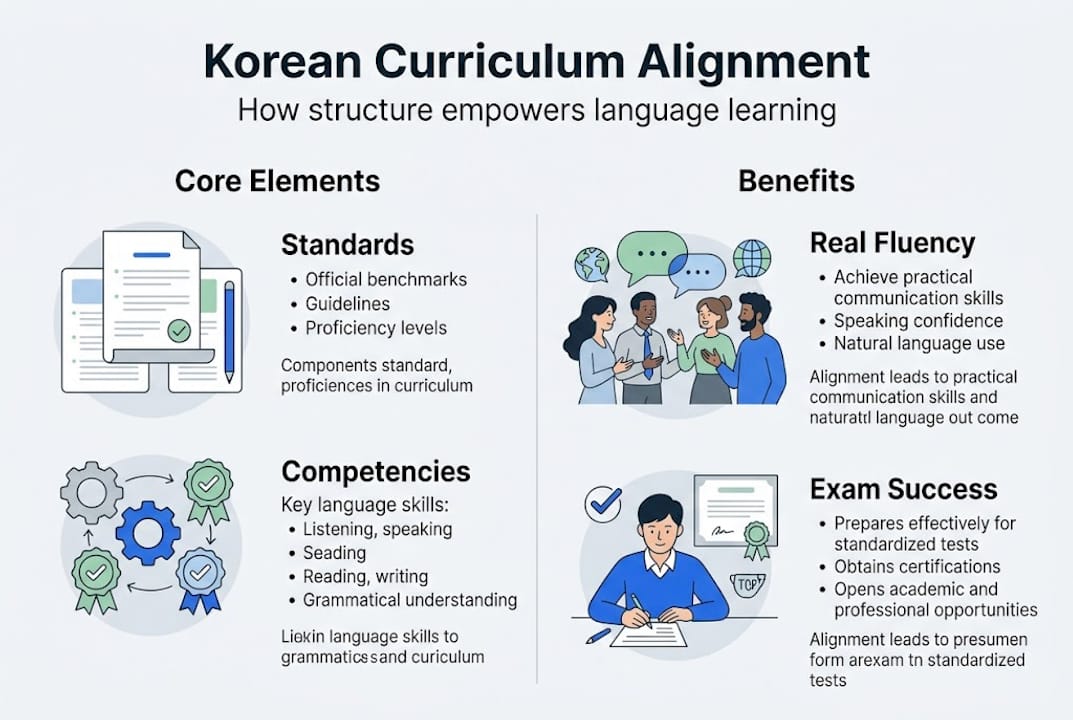
The shift became especially significant with the 2022 Revised National Curriculum, which introduced six core general competencies and reduced achievement standards to encourage deeper thinking over surface-level memorization. This is a major departure from older methods that rewarded students for reciting grammar rules without being able to use them.
Here’s how the two approaches compare:
| Feature | Traditional rote learning | Competency-driven alignment |
|---|---|---|
| Focus | Memorization and repetition | Critical thinking and application |
| Assessment | Written tests only | Listening, speaking, reading, writing |
| Skill depth | Surface level | Deep, transferable skills |
| Learner role | Passive receiver | Active communicator |
The six core competencies in the Korean national curriculum include:
- Self-directed learning: Taking ownership of your progress
- Creative thinking: Applying language in novel situations
- Critical reasoning: Analyzing and evaluating language use
- Communication: Expressing ideas clearly across contexts
- Community engagement: Using language for social connection
- Cultural literacy: Understanding Korean society through language
Pro Tip: When evaluating a Korean course in Singapore, ask directly whether the curriculum aligns with Korean Ministry of Education standards or an internationally recognized equivalent. Providers who can answer this clearly are the ones worth your time.
How the Korean curriculum is structured: spiral learning and achievement path
Understanding the purpose and standards, let’s see exactly how Korean is taught and measured through curriculum alignment.
One of the most effective features of a well-aligned Korean curriculum is the spiral learning model. Rather than covering a topic once and moving on, the spiral approach revisits concepts at increasing levels of complexity. You learn basic sentence structure early, then return to it with more nuanced grammar, then again in the context of formal versus informal speech. This builds genuine mastery rather than surface familiarity.

The spiral curriculum uses concept maps and a three-step instructional method that moves learners through conceptual understanding first, then procedural fluency, and finally practical application. This sequence mirrors how real language acquisition works. You understand a rule, you practice it until it feels natural, and then you use it in real conversations without thinking about it.
Achievement standards have also been significantly streamlined. Standards for Korean language were reduced from 118 in 2009 to just 61 in 2022, allowing for deeper focus on fewer but more meaningful skills. You can explore the full breakdown in the 2022 curriculum details.
Here’s how skill progression typically looks across learning stages:
| Level | Hours (approx.) | Key skills developed |
|---|---|---|
| Beginner (A1-A2) | 60-120 hrs | Hangul, greetings, basic sentences |
| Intermediate (B1-B2) | 150-250 hrs | Conversations, reading short texts |
| Advanced (C1-C2) | 300+ hrs | Debate, formal writing, nuanced speech |
For structured Korean learning, the achievement path follows these steps:
- Build conceptual knowledge of grammar and vocabulary
- Practice procedural fluency through drills and guided conversation
- Apply skills in real-world scenarios and assessments
- Review and revisit earlier concepts at greater depth
- Measure progress against defined achievement standards
“Achievement standards categorized as knowledge, process, and values ensure that learners develop the full range of language skills, not just test-taking ability.” — National Academies on Curriculum and Pedagogy
Curriculum alignment in practice: adaptation for Singaporean learners and proficiency tests
Having explored the system in Korea, let’s connect it to what Singaporean learners experience and how you can channel those standards for your own success.
In Singapore, well-structured Korean programs adapt national standards to fit adult learners with different goals. Whether you’re studying for personal interest, academic advancement, or a career in a Korean-speaking environment, the program structure should reflect your target outcome. Programs in Singapore use SNU, TOPIK, and King Sejong Institute materials to ensure international alignment and effective fluency outcomes.
Three proficiency benchmarks matter most for learners here:
- TOPIK (Test of Proficiency in Korean): Globally recognized, ideal for academic and professional credentials
- KLAT (Korean Language Ability Test): More practical and workplace-focused, with faster certification results
- CEFR equivalents: Used to map Korean levels to a globally understood framework (A1 through C2)
What should you look for in a curriculum-aligned Korean course in Singapore?
- Clear mapping to TOPIK or KLAT levels at each stage
- Use of SNU or King Sejong Institute approved materials
- Native-speaking instructors who teach communicatively, not just grammatically
- Regular assessments that mirror actual proficiency test formats
- Small class sizes that allow for speaking practice and real feedback
- Transparent course progression with defined outcomes per level
You can compare your options by exploring learning Korean in Singapore and checking where to take classes across different locations.
Pro Tip: Prioritize classes with small groups and native-speaking teachers. Curriculum fidelity drops significantly in large classes where speaking time per student is limited and feedback becomes generic.
The link between curriculum alignment, assessment, and real fluency
Let’s tie everything together by understanding why curriculum alignment matters not just in theory, but in shaping your exam results and language confidence.
One of the biggest misconceptions about exam preparation is that it means “teaching to the test.” In a properly aligned curriculum, the opposite is true. When your course is built around the same competencies that TOPIK or KLAT assess, exam preparation becomes a natural byproduct of real learning. You’re not cramming for a test. You’re developing skills that the test happens to measure.
The CSAT/EBS linkage in Korea’s national exams exceeds 50%, demonstrating how tightly integrated curriculum and assessment can be. The same principle applies to Korean language learning globally. When your classroom content and your proficiency exam draw from the same standards, your preparation is efficient and your results are meaningful.
Structured programs also dramatically reduce dropout. Self-study dropout sits at around 90%, compared to much lower rates in aligned, instructor-led programs. That gap isn’t about motivation. It’s about structure, accountability, and a clear progression path that keeps learners moving forward.
Here’s how curriculum alignment drives fluency step by step:
- Standards define what skills matter at each level
- Course materials are selected to build those specific skills
- Classroom activities develop both input (listening, reading) and output (speaking, writing)
- Assessments measure real skill transfer, not memorized answers
- Results feed back into the learning cycle for continuous improvement
The TOPIK and KLAT assessment frameworks use five achievement levels to measure learner progress. This gives you a concrete benchmark, not just a vague sense of “getting better.” For improving Korean through structured courses, this kind of measurable progress is what separates genuine fluency from the illusion of it. You can also review structured Korean achievements for real-world outcome data.
Nuances, edge cases, and what to watch for in curriculum-aligned Korean learning
Before you pick the right program, it’s important to recognize the edge cases, pitfalls, and subtleties that affect how alignment supports different learners.
Not all curriculum-aligned courses are built the same way. The label “aligned” can mean different things depending on the provider’s goals, teaching philosophy, and target learner. Here’s what to know before committing:
- Play-based or cultural courses: Great for beginners and hobbyists, but often lack the rigor needed for TOPIK or professional goals
- Workplace-focused programs: Prioritize practical communication but may skip formal grammar needed for advanced tests
- Academic-aligned courses: Follow SNU or Ministry of Education frameworks closely, best for learners targeting TOPIK Level 3 and above
- Hybrid programs: Blend conversation practice with structured grammar, often the most effective for adult learners in Singapore
Choosing between KLAT and TOPIK also shapes which program you should pick. TOPIK is the globally recognized standard for academic and immigration purposes. KLAT is faster to complete and more practical for workplace Korean, with an additional grammar section that TOPIK doesn’t include. The right choice depends on what it takes to master Korean for your specific goals.
Another edge case worth noting: some programs claim alignment but rely heavily on outdated textbooks that predate the 2022 curriculum revisions. This matters because older materials emphasize rote learning over the critical and creative thinking skills now required.
Pro Tip: Ask your course provider directly how they adapt assessments to encourage critical and creative thinking. If the answer is “we follow the textbook,” that’s a sign the program hasn’t caught up with modern curriculum standards.
Our perspective: what most guides miss about Korean curriculum alignment
With the formal aspects explored, here’s a crucial take you won’t find on an average information page.
Most learners, and honestly many schools, treat curriculum alignment as a checkbox. They point to a textbook series or a TOPIK pass rate and call it done. But real alignment is a living process. It means constantly asking whether your students are developing skills they can actually use, not just skills they can demonstrate on paper.
At Korean Explorer, we’ve seen what happens when learners follow a rigidly test-focused path. They pass TOPIK Level 2 and then freeze in a real conversation because they’ve never been asked to think creatively in Korean. Alignment without flexibility produces technically proficient learners who lack communicative confidence.
The most effective programs treat standards as a floor, not a ceiling. They use the full structured learning guide as a foundation and then build upward with conversation, cultural context, and adaptive teaching. For Singaporean learners especially, demanding that your school shows you exactly how their curriculum maps to recognized standards isn’t being difficult. It’s being smart about your investment.
Take the next step with curriculum-aligned Korean programs
Now that you understand what drives real results, here’s how you can make your next learning step count.
Knowing what curriculum alignment means is only useful if you act on it. Korean Explorer offers Korean language courses built on Seoul National University’s curriculum and closely mapped to TOPIK standards, giving you a structured path from beginner to advanced.
Whether your goal is passing TOPIK in Singapore, advancing at work, or simply holding a confident conversation, every course is designed with visible alignment to recognized achievement standards. Native-speaking instructors, small group sizes, and flexible scheduling mean you get structured learning without sacrificing real communicative practice. Your fluency journey deserves more than a random course. It deserves a curriculum built to get you there.
Frequently asked questions
What does Korean curriculum alignment mean for Singaporean learners?
It means your Korean course is structured to match national Korean standards and prepares you for tests like TOPIK, ensuring measurable and real progress. Programs in Singapore align with TOPIK, KLAT, and national standards for effective fluency outcomes.
Is curriculum alignment important for achieving Korean fluency?
Yes, courses aligned with recognized standards greatly improve fluency rates and significantly lower dropout compared to unstructured or self-study approaches. Structured learning consistently produces better fluency outcomes than self-directed study.
How do I know if a Korean course in Singapore is curriculum-aligned?
Look for courses using SNU or King Sejong materials, or programs that explicitly prepare you for TOPIK or KLAT tests with stated alignment to international standards. Most Singapore courses use SNU and Sejong materials mapped to TOPIK and KLAT benchmarks.
Which is better for me, TOPIK or KLAT?
TOPIK suits academic and global recognition needs, while KLAT is more practical for workplace goals and delivers faster certification results. KLAT is practical with quicker results, while TOPIK is the globally recognized academic standard.
Can curriculum alignment help if I am self-studying Korean?
Adopting official textbooks or following TOPIK and KLAT benchmarks can improve self-study results, but the dropout rate for self-study remains around 90% compared to structured, aligned programs.